By Aurra Kawanzaruwa
Most of us remember where we were when ChatGPT arrived. It went public in late November
2022, and by January 2023 it had an estimated 100 million monthly users [Reuters, 2023]. Within weeks, students were handing in essays it had written and teachers were asking us for guidance we hadn't written yet. The questions at the heart of our work stayed the same. The speed didn't, and our field spent the next few years catching up.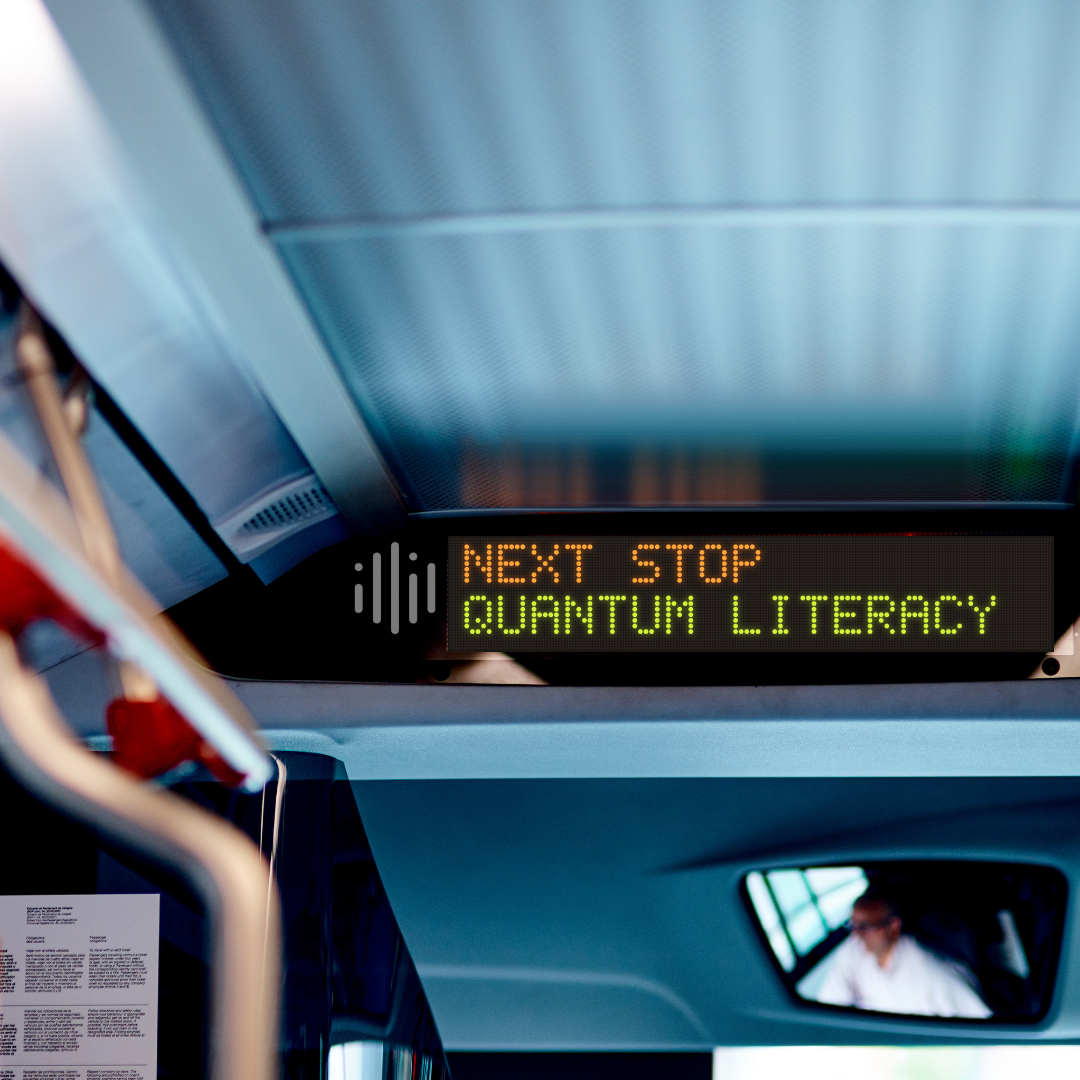
I think the next one's already on its way. On 2 October 2026, I moderated the Africa Quantum Consortium's quarterly roundtable, Humanising Quantum. I opened by asking the audience whether they knew that researchers in South Africa and China had used a satellite to share encryption keys across about 12,900 kilometres [Stellenbosch University, 2025]. Most people typed no. That small poll stayed with me, because it looks a lot like where AI was a few years before it reached our classrooms.
Looking back at AI, the literacy arrived late. UNESCO's AI competency frameworks for students and teachers came out in 2024, nearly two years after ChatGPT went public [UNESCO, 2024]. By then the public story had already been written, mostly by the companies building the technology and by headlines that swung between miracle and apocalypse. Literacy that arrives late also tends to arrive as instructions for use. A recent critique argues that much AI literacy treats people as consumers learning to use tools wisely, rather than as citizens with a say in how those tools are built [arXiv, 2026]. And the hardest questions, about the electricity, water and labour behind AI, came last.
Dr David McCollum of Oak Ridge National Laboratory gave the roundtable a thought experiment. Some of the first graphics processing units, the chips that now power AI, went into his lab's supercomputer around 2007 as an experiment. About ten years later they were moving into data centres, and a few years after that they were everywhere. The first quantum computers are now being connected to supercomputing centres in the United States, Europe, Japan and Australia. Quantum may move on a different timeline, but his question is worth asking anyway.
"What would we have done differently in the year 2007, 2010, if we could have seen the AI revolution coming?"
There's one big difference. AI arrived as something you could open and talk to. Quantum is more likely to arrive quietly, inside the systems that secure our messages, verify our media and move our money. Most people will never touch a quantum computer. That's familiar ground for us, since much of our work already involves teaching people to question systems they cannot see.
You don't need physics to follow any of this. Quantum physics describes how the smallest pieces of matter and light behave, and it's already part of daily life, from the transistors in our phones to the atomic clocks behind GPS and the MRI scanner at the hospital [NIST, 2025]. The newer wave includes quantum computers, which are expected to be powerful for specific problems such as simulating molecules for new medicines. It also includes quantum communication, like that satellite link, and quantum sensing, which measures things like time and gravity with great precision. One correction worth carrying into any classroom: quantum computers won't be faster at everything, and they don't "try every answer at once." That phrase is exactly the kind of tidy simplification our field is trained to notice.
Quantum hype is already a media literacy problem: Researchers at Durham University define quantum literacy as a basic grasp of core ideas plus the ability to assess claims made about quantum technology [Nita, Mazzoli Smith and Chancellor, 2021]. That second half? That's our discipline. Research by Aletta Meinsma at Leiden University found that about two in three people have heard little or nothing about quantum technology, and that around a quarter of the articles and videos she studied framed it as mysterious or "spooky" [The Quantum Insider, 2026]. Another study of more than 2,300 news articles found coverage drifting away from science and towards national strategy and rivalry between countries [The Quantum Insider, 2025]. Add "quantum" printed on wellness products, and press releases announcing breakthroughs that are years from any real use, and it all starts to look very familiar. Someone who's quantum literate can ask what's actually being claimed, who gains from the claim, and whether it describes a lab result or a promise for 2040.
At the roundtable, Dr Sarah Young of the University of Arizona, who came to quantum from journalism and rhetoric rather than physics, said that in a field this young you sometimes have to make the language yourself. Cierra Choucair, who co-hosts the ITU's Quantum World Tour, offered advice any media educator will recognise. Because most of us never see quantum at work, she said, look for the human side of the story and ask how it will affect people now and later.
The deeper stakes are trust and proof: Much of the encryption that protects private messages, journalists' sources and medical records could, in principle, be broken by a powerful enough quantum computer in the future. Some actors are already collecting encrypted data in the hope of reading it later, a strategy known as "harvest now, decrypt later." In August 2024 the US National Institute of Standards and Technology published its first standards for quantum-resistant encryption, starting a migration that will take years [HPCwire, 2024]. For anyone who teaches digital privacy or source protection, "encrypted" is now a promise with an expiry date.
Proof is affected too. Many of us now point students to Content Credentials, the C2PA standard that attaches a tamper-evident record of where an image or video came from. That system depends on digital signatures, and the C2PA says it plans to support NIST's new quantum-resistant signature standard once common software can handle it [C2PA, 2026]. The C2PA itself describes Content Credentials as a complement to media literacy rather than a replacement. Quantum also brings new claims of its own. Quantum communication is often sold as "unhackable," yet the record-breaking link between China and South Africa used the satellite as a trusted relay between ground stations [Chinese Academy of Sciences, 2025]. Somebody in the middle still had to be trusted, and that's exactly the kind of question we ask of any system that claims perfect security.
Who tells the story is still open: With AI, the dominant frames came from a small number of companies and countries. Adrian Schmidt, who studies the societal impact of technology in Germany, told the roundtable that even Europe talks about quantum through frames borrowed from elsewhere, and that those frames shape what gets funded and built. Nadia Armstrong, an artist and quantum communications researcher in Dublin, pointed out that the people building less equitable futures understand the power of myth very well, and that's why folklore and art belong in this conversation.
Africa isn't starting from nothing. Egypt, Ghana, Senegal and South Africa were among the countries behind the UN resolution that made 2025 the International Year of Quantum [Nature Africa, 2025]. In New Alamein, Egypt, students working with Professor Ahmed Younes took quantum onto the streets with games of their own design, reached around 750 visitors and placed first in Africa in the 2025 Quantum City Prize [World Quantum Day, 2026]. In Guangzhou, Lingxiao Han paired quantum computing with the I Ching, because plenty of people who've never heard of a qubit know fortune telling well.
That's where my own work on Ubuntu and quantum comes in. Umuntu ngumuntu ngabantu: a person is a person through other people. Read through Ubuntu, quantum literacy is something communities build together, and a technology is judged by what it does to the people and land it touches. Cultural intelligence is what lets us meet each learner where meaning already lives for them, whether that's an I Ching reading, a street game or a proverb.
The footprint question can come first this time: AI literacy now includes the electricity, water and minerals behind every chatbot answer, but we learned to ask about them late. Dr McCollum's research suggests that future quantum computing could use energy and water on a scale close to today's AI data centres, or far less, and he was upfront that nobody knows yet. He also pointed to critical materials like helium-3, niobium and tungsten, and a lot of them are found in Africa. Sierra Re' Hyson, who supports deep-tech companies in Seattle, warned against copying the AI growth playbook, since a path built only on supply chains can turn extractive very quickly. Who bears the costs, and who shares the benefits? Communities on this continent have heard that question before, in mining, oil and data.
Quantum literacy doesn't need a new discipline: It needs ours. Renee Hobbs' AACRA framework (access, analyse, create, reflect and act) carries over directly [Hobbs, 2010]. Access means helping learners find trustworthy sources on quantum, and noticing who gets access to its tools and education at all. Analyse can be as simple as setting a quantum press release beside the research it describes. Create is where the roundtable shone, from the students' street games to Scott Oshiro's music made with quantum systems he built, a journey he began at an IBM hackathon in South Africa without a physics degree. Reflect asks what quantum hardware will need from our water and power. Act means asking our banks, governments and newsrooms whether they are preparing for quantum-safe encryption.
With AI, we met the technology first and built the literacy afterwards. With quantum, I believe we've got a rare chance to reverse that order.
Comments(0)