 As Pope Leo XIV's first encyclical, Magnifica Humanitas: On Safeguarding the Human Person in the Time of Artificial Intelligence, lands in the middle of an accelerating global debate over AI governance, educators and media literacy advocates face a pointed question: what does it mean to keep human dignity at the center of technological change? Signed on May 15, 2026, the 135th anniversary of Pope Leo XIII's landmark social encyclical Rerum Novarum, and released on May 25, the 42,000-word document extends the Church's social teaching tradition directly into the age of algorithms, automated decision-making, and AI-driven information environments. Its core claim is urgent and ecumenical: technology is never neutral, and the civilization we are building with these tools will reflect the values, incentives, and power structures of the people building them.
The encyclical does not traffic in technophobia. It acknowledges AI as a potentially valuable tool while insisting that human dignity precedes and judges technological progress, not the reverse. Among its most pointed arguments for educators: a warning that a culture of immediacy atrophies attention and critical thinking, a call to consider "fasting from artificial intelligence" to protect the inner freedom of rising generations, and a challenge to ask, in every context including schools and libraries, whether our technologies are serving human dignity or quietly eroding it. These are not abstract theological claims. They are questions media literacy educators have been wrestling with for years, and this document gives them new institutional and moral weight.
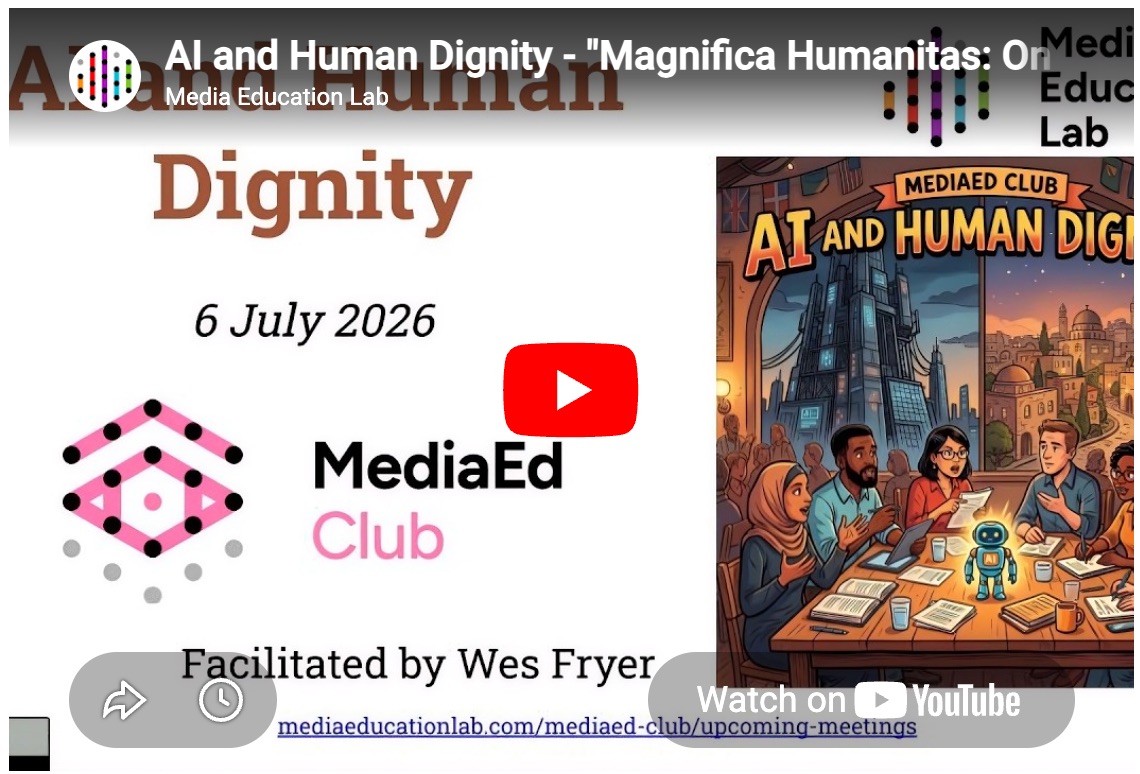
Join the MediaEd Club on July 6th for an evening panel discussion on Magnifica Humanitas and the broader questions it raises about AI ethics, education, and our shared digital future. Panelists will explore the encyclical's key arguments, examine secular and cross-faith responses to its framework, and discuss what its call for discernment looks like in concrete classroom and library practice. Whether you approach these questions from a faith perspective or not, this is a conversation about the kind of future we are building together, and what it means to remain genuinely human while building it.
Date: Monday, July 6, 2026
Time: 7 pm ET | 6 pm CT | 5 pm MT | 3 pm PT
Archived Video on YouTube - Playlist of our Archived Meetings
SIGN UP here to receive our newsletter with updates and details on media club, webinar series, and teaching resources.
Recommended Media (please preview before attending)
- Encyclical: Magnifica Humanitas: On Safeguarding the Human Person in the Time of Artificial Intelligence (Pope Leo XIV, The Holy See, 25 May 2026). Read at minimum the Introduction and Chapter Three ("Technology and Dominance").
- Article: Magnifica Humanitas: A Reader's Guide (Luke Coppen, The Pillar, May 2026). A clear, chapter-by-chapter orientation to the document.
Optional Media (enrich your learning)
- Article: Pope Leo Uses First Major Papal Text to Warn About Dangers of AI (TIME, 25 May 2026).
- Article: Reactions to Magnifica Humanitas Reveal Anxieties of the AI Age (The Catholic Herald, May 2026). Surveys how secular and religious outlets across the political spectrum responded.
- Article: Anthropic Co-Founder Warns on AI Ethics at Vatican (EWTN Vatican, 25 May 2026). Christopher Olah's remarks at the encyclical's presentation in the Vatican's Synod Hall.
- Article: Two Magnificences: A Secular Response to Magnifica Humanitas (EU AI Alliance / Futurium, May 2026). A governance-and-medicine perspective on the encyclical's core claims, written outside any theological tradition.
- Article: Magnifica Humanitas: A Comprehensive Reading (Catholic Outlook, May 2026). Detailed analysis including the encyclical's concrete proposals on labor, education, autonomous weapons, and the protection of minors.
- Panel discussion: Magnifica Humanitas (Georgetown University's Center for Social Thought, 2 June 2026). Features Notre Dame philosopher Meghan Sullivan, Vatican Bishop Paul Tighe, and Daniel Daly, co-host of the podcast Ethics on Call.
- Article: "Magnifica Humanitas": Human Dignity in the Face of Artificial Intelligence (Omnes, May 2026). Examines the encyclical's core principle: human dignity precedes and judges technological progress, not the reverse.
Other Links Mentioned During the Webinar
- Slide deck for the session (Google Slides)
- "Share Where You Share" Feedback form (Google Forms)
- Confronting Whiteness (Rev. Ben Boswell's anti-racist curriculum project)
- Resistance 500 / The 1526 Project (Boswell's newly launched curriculum on 500 years of resistance to slavery and settler colonialism)
- Rerum novarum (Wikipedia, the 1891 encyclical that founded Catholic social teaching)
- Frankenstein (Wikipedia, discussed at length as a metaphor for AI creation and abandonment)
- Fediverse (Wikipedia)
- Empire of AI: Dreams and Nightmares in Sam Altman's OpenAI, by Karen Hao
- "Gracious AI Ethics" TEDxUniversityofGroningen talk by Lisanne Buik
- Song clip from the musical Ragtime
- Civics of Technology conference (Aug 6-7, 2026, free/virtual, theme "Against Tech Hype")
- Media Ed Club collaborative notes hub
- (Shared by Ben afterward) Jacques Ellul's famous book "The Technological Society" (1964)
- (Shared by Ben afterward) "Why I am Not Going to Buy a Computer" by Wendell Berry (2000)
Host: Dr. Wesley Fryer
 Wesley Fryer, PhD, is a middle school STEM and media literacy middle school teacher at Providence Day School in Charlotte, North Carolina. As an educational technology "early adopter / innovator" since the late 1990s, Wes continues to share regularly on social media. Learn more on wesfryer.com.
Please get in touch with us if you want to suggest future Media Club meeting topics to discuss an article, book, podcast, video or any media related to our interests.
Dr. Wes Fryer, Webinar Series Manager | wes.fryer@providenceday.org
* AI Image (for this webinar) generated by Wes Fryer using Gemini.